The demo and presentation were the perfect way to wrap up a very busy and successful term of work on “Witness to the Revolution”. I have been incredibly lucky to be a part of this project, and I have learned and grown so much as the game has begun to develop. At the beginning of the term, I was expecting to work primarily on sound for the game, but by the end I had shifted to work primarily on narrative. The work on narrative has definitely been challenging, but I also believe it has been incredibly rewarding to take primary sources and transform them into a working narrative for a video game. I got to speak at our presentation on how we researched the Boston Massacre and how we used this research to create a main narrative.
 Loading...

 Reload document
  Open in new tab
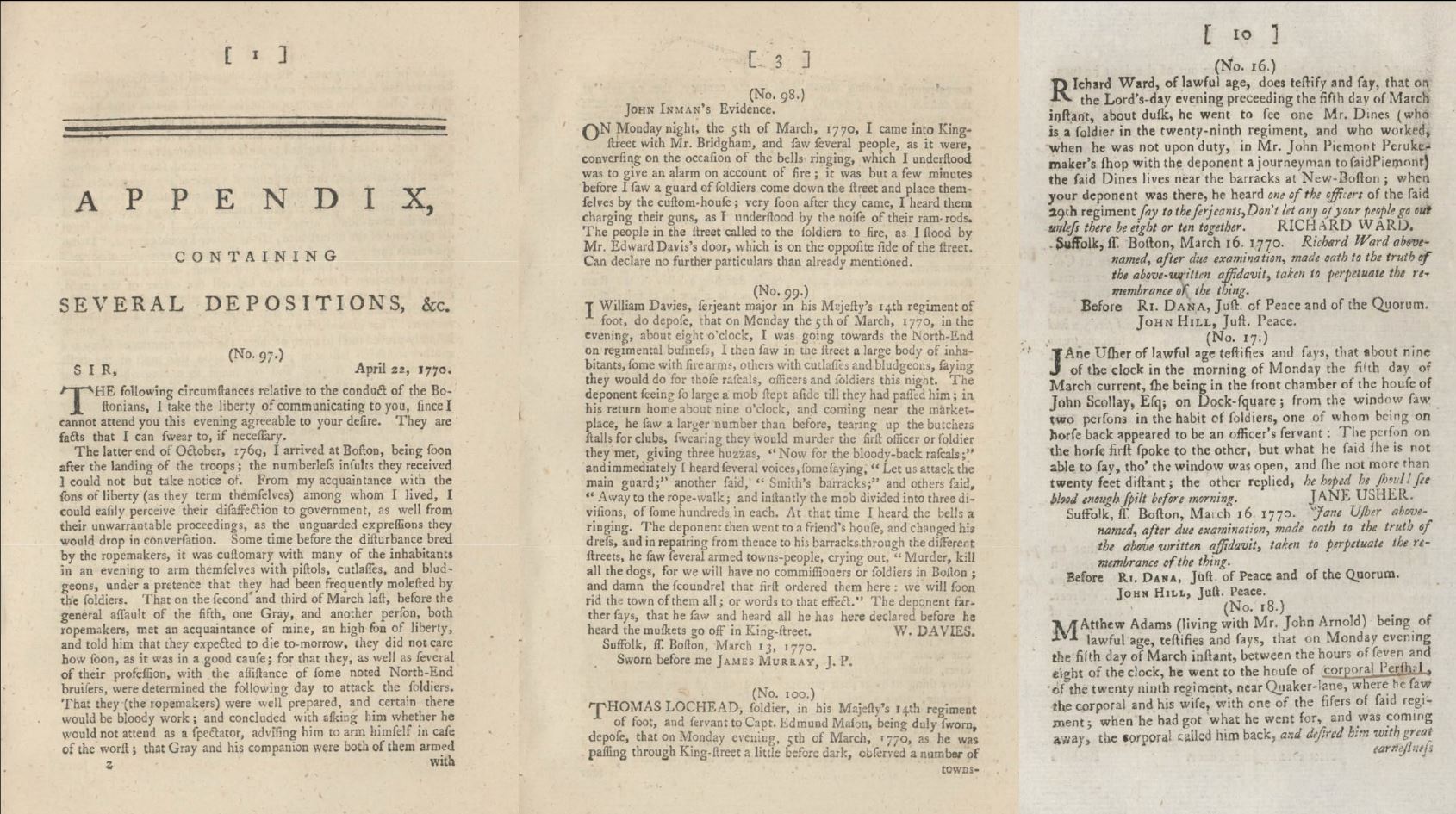
 From the very beginning we knew that we wanted the game’s narrative to be as historically accurate as possible, and our main research consisted of looking at depositions of the events leading up to March 5, 1770, and the massacre itself. The depositions were invaluable primary sources, and they acted not only as a solid foundation for our game’s narrative but also as jumping off points for understanding Boston at that moment in time. We looked primarily at two pamphlets printed after the massacre: the “Fair Account of the Late Unhappy Disturbance at Boston”, a pamphlet with military depositions collected by soldiers, and the “Short Narrative of the Horrid Massacre in Boston”, which was created by Boston’s Sons of Liberty. We also looked at depositions from the Adams Papers in order to examine depositions from the actual trial of the soldiers involved in the massacre. We were able to ground a lot of our research when examining sounds by making a spreadsheet of important sounds and dialogues presented by the depositions relating to the massacre. This allowed us to use our initial research to begun crafting a main narrative.
Due to the nature of our primary sources, the depositions collected were inherently biased towards the people of Boston or to the soldiers. The depositions also brought into sharp relief the complicated nature of relationships between civilians and soldiers in Boston in the 1770s, and this became an important aspect of the narrative we wanted to create. We wanted to use the different depositions to bring in different relationships and pose questions of bias and reliability in our main narrative. Our original idea for the narrative was that the player would collect depositions to craft their own understanding of the Boston massacre, but the vast number of depositions and information that was presented in research forced us to consider how to make this narrative fit into a game setting. One of our first ideas was that at the beginning of the game, the player would be assigned the role as a deposition collector for either the Sons of Liberty (depositions from the Short Narrative) or the soldiers (depositions from the Fair Account). That would allow the player to follow one specific path and gain understanding of the event based on depositions as the source.
However, the relationships that we knew were present in Boston complicated this narrative. Two different paths did not lend itself to a narrative that really showcased the complexity of relationships and of the event itself, and would only create two possible endings: one that favored the soldiers and one that favored the Sons of Liberty’s perspective. We didn’t want separate the conflict accounts, we wanted to bring them together. Because historical accuracy was the foundation of our narrative, we needed conflicting accounts to showcase the true uncertainty of the event that our primary sources describe to us. We needed to change our main narrative so that it included the conflicting accounts and the complicated web of relationships in Boston, for example the fact that Jane Whitehouse’s deposition favored the soldiers when she married a soldier. Our new main narrative would follow the player as they collected depositions after the massacre from people from different walks of life in Boston, and after a certain number of depositions were collected (we chose three as a starting number), the player would then be sent to the State House. The State House would set the scene of the recreation of the event based on the depositions collected in that particular playthrough. We wanted this “end game” to render the player’s own understanding of the event, and in doing so would highlight the historical uncertainty that must be considered when examining the Boston massacre. To do so, we decided that the end game would involve a screen with a series of variables, pulled from the depositions collected, that the player would then manipulate to create their own version of the Boston massacre. Variables would differ depending on the information presented in the depositions collected, but some examples would include crowd size, mood of the crowd, what the crowd was holding or even where Captain Preston was standing. Depending on which depositions the player chose to collect, the outcome of the endgame event would change. This allowed us to bring in conflicting accounts based on historical fact and provide the player with the opportunity to render their own understanding of the event that would change with each playthrough.
The process of getting to this main, base narrative involved primarily research of depositions, but it also opened up a much larger question of how we record more voices than just men giving depositions. We want to base our game on historical fact, and we are committed to showing more than just literate white men. It remains an important step in the narrative process to find the voices of women, slaves, or simply individuals between classes and races. For me, it was important to express this to our audience at the presentation in order to highlight the issues of basing the narrative on historical fact when history itself has been shaped by those with voices.
I’m very passionate about how we created our main narrative and the complex research that is required to continue it, so I was very excited that the presentation allowed me to explain the process to people who might potentially join in on our project in the future. Although I can’t be as involved next term, I will definitely try to act as a support for continuing research and supporting our narrative. This experience has been a completely new one for me, and I think everyone should be involved in a project that works to bring something to life in a new way for people to not only learn, but also enjoy. Many people seem to write off history immediately as boring and irrelevant to everyday life, and I hope a project like this can bring history to a mass audience in a way that showcases how interesting and complex history truly is. Our project will bring history to life through new, fun and interactive means, and I truly believe it will be an enriching experience. It was incredible to work with a tight-knit group of individuals who are really passionate about this project, and I can’t wait to see how far I know we can go.
